
Synopsis
Estes Collision in Miami, OK, explains why addressing collision repair after a car accident before a summer road trip protects your vehicle, your family, and your investment.
Key Takeaways
- Unrepaired collision damage worsens under highway speeds and summer heat.
- Even minor post-accident damage can compromise structural protection in a second impact.
- Bumpers, frame alignment, paint gaps, and glass are the most commonly overlooked damage types.
- Insurance-approved collision repair is cleaner, faster, and less complicated when started promptly.
- A professional assessment helps to know exactly where your vehicle stands.
Driving with unresolved accident damage on a long road trip puts more at risk than most drivers realize. Summer conditions like heat, high-speed travel, rural road debris, and severe weather stress every compromised component far harder than everyday city driving does. Getting collision repair after accidents is the decision that protects everyone in your vehicle during summer rides.
At Estes Collision, we see drivers arrive after a long drive with a bumper that partially detached on the highway, or a frame pull they first noticed on the interstate. The damage existed before the trip. Highway conditions made it worse.
What Unresolved Collision Damage Does to Your Vehicle
Collision damage rarely stays isolated. When a vehicle takes an impact, force transfers through adjacent panels, welds, and structural components in ways that are not always visible from the outside. A front bumper hit, for example, can compromise the bumper absorber, mounting brackets, the fascia, and, in harder impacts, the frame rails behind them.
Many drivers who need collision repair after a car accident delay the work, assuming it can wait. Hidden damage: creased metal, stressed welds, panels out of alignment, does not announce itself. Under sustained load and heat, it weakens further.
The Insurance Institute for Highway Safety (IIHS) evaluates how well a vehicle’s occupant compartment holds up in a crash. When prior damage has already compromised that structure, the vehicle cannot perform the same way in a second impact. Crumple zones absorb energy in a controlled sequence. Prior unrepaired damage disrupts that sequence before the next collision ever happens.
Oklahoma summer heat compounds this. Heat expands metal, widens panel gaps, and softens sealants. Damage that held through a mild spring can shift noticeably on the first long highway run in June.
How Summer Road Trip Conditions Amplify Existing Damage
City driving rarely reveals what a highway exposes. At low speeds, a slightly misaligned bumper holds. A small panel gap admits little wind or debris. At 65 to 75 miles per hour, that changes.
According to the Insurance Institute for Highway Safety (IIHS), summer and early fall are the most dangerous seasons for traffic fatalities in the United States, with July and August having the highest daily toll of any month. This increase reflects that Americans drive more miles during warm summer months. More vehicles, more miles, and a structurally compromised vehicle raise your exposure in that environment.
Sustained speed puts constant aerodynamic pressure on every panel, seal, and fastener. A loose front fascia catches the wind like a sail. A panel with compromised mounting hardware vibrates with every mile. Over a 300-mile drive through northeastern Oklahoma and into Kansas, that vibration compounds steadily.
Rural highways serving Miami, OK, and surrounding communities, including US-69 and OK-125, carry gravel, road tar, and debris from agricultural traffic. A vehicle with open panel gaps or exposed paint from a prior collision takes the full impact of that debris on bare metal.
Oklahoma summers also bring fast-moving storms. The NWS Tulsa office monitors this region for severe weather: hail, high winds, and tornadoes, from late spring through summer. A vehicle with compromised glass seals or weakened body panels faces meaningfully greater risk from hail and wind-driven debris.
The Damage Types Drivers Most Often Overlook
These are the issues we see most consistently in vehicles that come in before or after summer travel.
Bumper Damage
A damaged bumper is not a cosmetic problem; it is a structural and safety one. Modern bumpers house energy absorbers, impact foam, and in many late-model vehicles, parking sensors and cameras mounted behind the fascia.
Bumper collision repair restores the mounting hardware, the absorber, and the fascia together. A cracked or misaligned bumper left unrepaired creates a real detachment risk at highway speeds and leaves the systems behind it unprotected in any subsequent impact.
Frame and Structural Misalignment
Even a low-speed collision can push a vehicle’s frame out of factory tolerance. In a parking lot, you may not notice it. On a four-hour highway drive, a pull to one side becomes impossible to ignore.
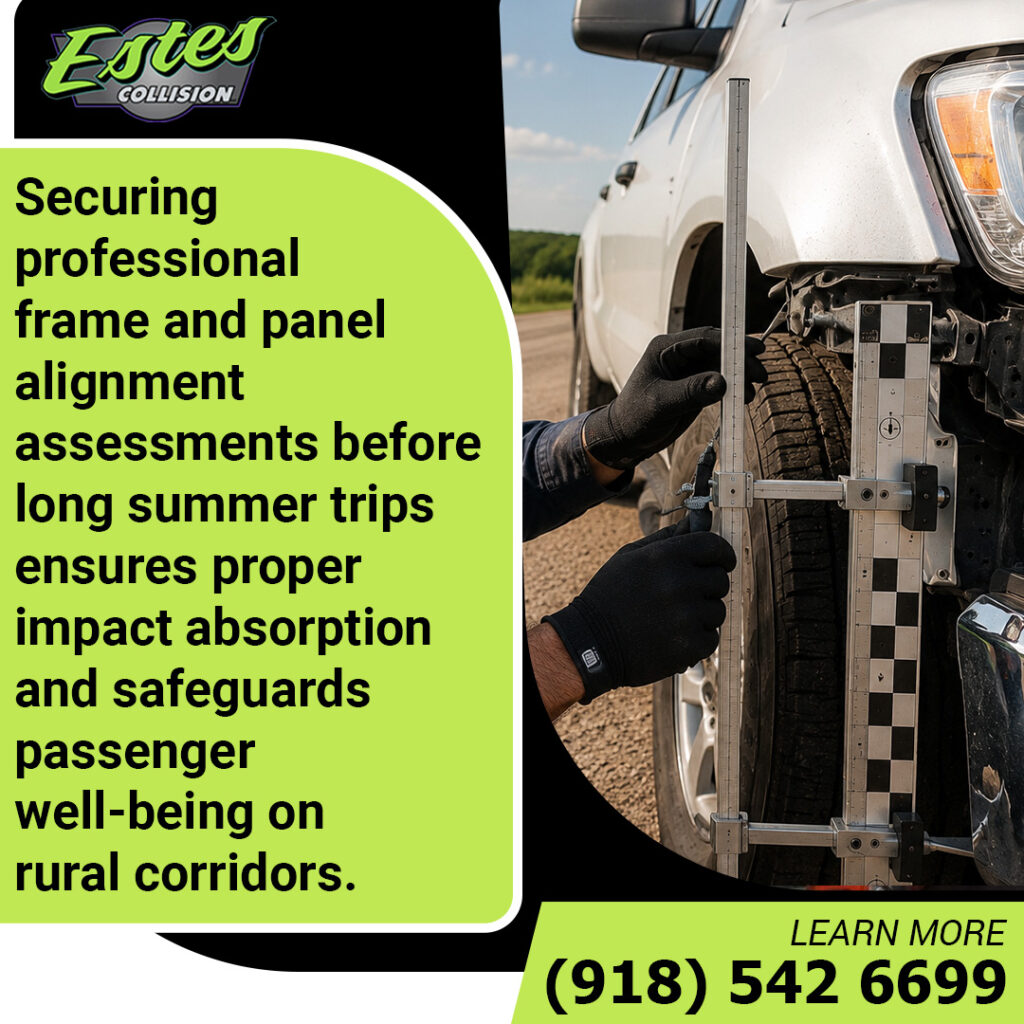
Frame misalignment can create uneven tire wear and place abnormal stress on suspension components. In more significant structural impacts, it may also affect how crash-management structures align and function. We follow OEM procedures to assess and correct frame alignment, restoring structural geometry to factory specifications.
Paint, Panel Gaps, and Glass
Small gaps between body panels after a collision allow moisture and debris into areas that should be sealed. Oklahoma’s summer humidity can accelerate corrosion on exposed metal, while intense UV exposure can accelerate paint and clear-coat deterioration.
Gaps that seem minor in May can cause significant moisture intrusion by August. Heat cycling, warming through the day and cooling at night, expands and contracts metal, widening those gaps over time. Chipped or cracked glass, including windshields and side windows, also seals against weather and road noise. Compromised glass worsens with vibration and temperature changes on a long drive.
The table below shows how each of these damage types rates as a road trip risk.
| Damage Type | Safety Concern | Recommended Action |
| Bumper misalignment or detachment | Reduces crash protection; causes expensive repairs in low-speed crashes | Repair before driving |
| Frame/structural damage | Compromises crashworthiness and structural integrity | Repair before driving |
| Panel gaps | Allows moisture/debris entry, causing corrosion over time | Repair promptly |
| Cracked or chipped glass | Weakens windshield’s rollover protection and airbag support | Repair before driving |
| Paint failure on bare metal | Leads to rust and structural corrosion | Repair promptly |
Why Insurance-Approved Collision Repair Should Happen Before You Leave
Delaying a repair after an accident does not work in your favor. If your vehicle sustains additional damage on a road trip and an adjuster evaluates the claim, pre-existing unrepaired damage complicates the assessment. It can create disputes about which incident caused what, and that costs you time and potentially money.
Insurance-approved collision repair means the work is documented, completed to carrier standards, and covered under warranty. The process is straightforward when it starts close to the original incident.
Estes Collision works directly with most major insurance carriers and manages the coordination, documentation, supplemental assessments, and billing on our end.
Starting the claim before your trip gives you the best chance of completing the repair in time. The earlier the process begins, the more scheduling flexibility you have.
What a Pre-Road-Trip Inspection Covers at Estes Collision
A walk-around is not a damage assessment. Professional collision repair technicians check things the naked eye cannot catch from a driveway.
At Estes Collision, our pre-trip inspection process covers:
- Frame alignment: measured against factory specifications, not visually estimated
- Panel gaps: checked at every seam for consistency and moisture intrusion risk
- Glass condition: windshield and side glass inspected for chips, cracks, and seal integrity
- Paint adhesion: repaired areas checked for lifting, bubbling, or bare metal exposure
- Bumper structure: mounting hardware, energy absorber, and fascia all assessed
- Structural welds: reviewed for stress signs in areas affected by the original impact
This is full-service collision repair in practice: assessment, documentation, and the complete repair handled in one place. Whether you need collision repair after a car accident that caused frame damage, paint failure, or bumper detachment, our team handles it all under one roof. Our free estimate takes 15 to 30 minutes. You leave knowing exactly what your vehicle needs, with no obligation to proceed.
How Long Does Collision Repair Take?
Repair time depends on damage severity, parts availability, and insurance approval pace. There is no universal timeline, and we do not quote one without seeing the vehicle.
Starting early gives you options. A repair scheduled two weeks before departure is manageable. Three days out may not be. Panel and paint work generally moves faster than structural correction, which involves more measurement and verification steps.
Schedule the estimate first. Once we assess the vehicle, we walk you through what is needed and what the insurance process looks like, clearly, without guesswork.
What Sets a Reliable Auto Collision Shop Apart
Not every auto collision shop follows the same standards. Before your trip, these are the things worth confirming:
- OEM procedure compliance: Does the shop follow manufacturer repair procedures for your specific vehicle?
- Warranty coverage: A limited lifetime warranty means the shop stands behind the work throughout your ownership of the vehicle.
- Insurance coordination: Direct carrier coordination reduces your administrative burden.
- Industry memberships: Membership signals adherence to professional repair standards. Estes Collision, for instance, is a member of the Oklahoma Auto Body Association (OKABA).
Estes Collision meets all four of these. Founded in 2015 by Billie and Amanda Estes, we are a family-owned shop that has grown. We are a proud OKABA member, our repairs carry a limited lifetime warranty, and our team handles insurance coordination directly. We use Sikkens paint with electronic color matching for a factory-quality finish on every paint repair. We serve drivers in Miami, OK, and surrounding communities, Fairland, Afton, Commerce, Baxter Springs, Grove, Vinita, and Wyandotte.

Frequently Asked Questions
My damage looks minor. Is an inspection really necessary?
Minor-looking damage frequently hides frame or structural issues that only appear under road stress. The only way to confirm your vehicle is road-ready is a professional assessment. Our free estimate takes 15 to 30 minutes and gives you a definitive answer.
Can I start an insurance claim and still make my travel date?
Yes, if you start early. We manage the insurance side on our end and work to move the process as efficiently as the repair scope allows. Do not wait until the week before your trip to begin.
Does Estes Collision handle bumper repair and frame straightening at the same shop?
Yes. Bumper repair, frame straightening, paintless dent repair for eligible damage, and full collision repair after a car accident are all handled at our facility, following OEM procedures on every job.
Get Your Vehicle Road-Trip Ready
Summer is here. Do not drive with unresolved collision damage when a free estimate takes less time than an oil change. Whether your vehicle needs front-end repair, frame straightening, glass replacement, or a full post-accident auto body inspection, you want the best collision repair shop in Miami, OK. Estes Collision is ready to help. We take the drama out of collision repair.
Call us at (918) 542-6699 or email [email protected] to schedule your free estimate. We take care of your collision repair needs and get you back on the road hassle-free.